How the most advanced optics in today's smart glasses are made
Producing a single augmented reality waveguide is an optical feat. Producing millions with consistency, efficiency, and room to grow will define the future of smart glasses.

Scaling geometric reflective waveguides from optical breakthrough to high-volume manufacturing is redefining what’s possible for AR smart glasses.
- In Kulim, Malaysia, SCHOTT built a purpose-designed factory to bring waveguide technology into serial production.
- A high manufacturing yield and modular expansion model enable smart glasses to move toward mainstream adoption.
- Continuous optical innovation expands brightness, field of view, and real-world wearability.
For augmented reality to reach the mass market, everything hinges on the waveguide – the optical lens that channels digital information into the user's eye. However advanced the software or refined the industrial design, the demands placed on this component are unforgiving: thin, light, crystal clear. Any type of defect or misalignment appears instantly in the user’s field of view.
“The latest smart glasses require specs that never existed before,” says Stefan Weidlich, Head of Product Design for Augmented Reality at SCHOTT. “From the very start, the challenge to develop these waveguides – and manufacture them at scale – was intense.”
Stefan sees AR as the next technological inflection point, bringing digital information directly into our line of sight. But like many technological breakthroughs before, realizing AR’s true potential depends less on concept demos and more on industrial discipline.
"It’s one of the most advanced pieces of optics our team has ever created,” Stefan adds. “Scaling for mass production required rethinking nearly everything – which is why we built an entirely new factory in Malaysia in 2024.”
Rethinking everything
Built to industrialize waveguide technology for augmented reality, SCHOTT’s state-of-the-art manufacturing facility in Kulim, Malaysia, marked a turning point: the company became the first to scale geometric reflective waveguides from development into high-volume serial manufacturing.
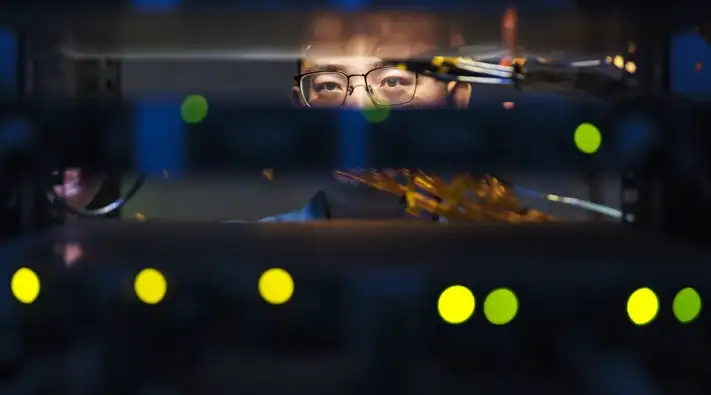
Having to overhaul centuries of optical glass production expertise might sound intimidating. But for Yong Hong Ch’ng, Head of Development and Application for AR at SCHOTT Malaysia, it meant going back to first principles. “The challenge was enormous, but we just started working. Step by step,” Yong explains. “We looked at everything. Every single process of waveguide production.”
“Coating refers to the application of special layers onto glass substrates that will later guide light,” he explains. For geometric reflective waveguides, uniformity is everything. “In waveguide mass production, that was a huge challenge: achieving consistent quality across thousands of parts without any deviations.”
Next comes stacking, where multiple coated layers are aligned and bonded. “Even the slightest misalignment would deteriorate the final image,” he says. To prevent that, the team developed entirely new alignment and bonding techniques capable of delivering absolute precision.
Then slicing: cutting the stacked blocks into thin sheets with micrometer accuracy.
“Imagine, one micrometer equals the size of a bacterium, or a fine dust particle,” Yong says. “There’s zero room for failure.”





After cutting, the surfaces are polished to a flawless finish. “Geometric reflective waveguides need a mirror-like surface,” he explains. “Even the tiniest scratches or irregularities would immediately show up in the image.”
Shaping follows, forming the glass into its final geometry. “It is one of the final steps,” Yong continues, “turning the glasses into geometric reflective waveguides.”
Finally comes inspection. “We developed new methods to detect even microscopic flaws,” he says. “Only those waveguides that are absolutely flawless find their way into smart glasses.”
All of these steps converge on a single metric: yield. And with a proven consumer-grade yield in serial manufacturing, SCHOTT significantly reduces material waste, lowers unit costs, improves efficiency, and strengthens supply reliability – advantages that become decisive as wearable devices such as smart glasses move toward mass adoption.
“Every step adds complexity to an already complex component,” Stefan says. “What makes me proud is that not only did the team develop a new manufacturing process to handle such complexity, they pushed it to a level of yield that fundamentally changes what’s possible at scale.”
Because the new SCHOTT Kulim site was designed for modular expansion, capacity can grow in step with demand. The team has the flexibility to build up additional lines in order to ramp up output to millions of units annually.
If waveguide manufacturing once constrained the trajectory of AR’s consumer adoption, that constraint has materially shifted.

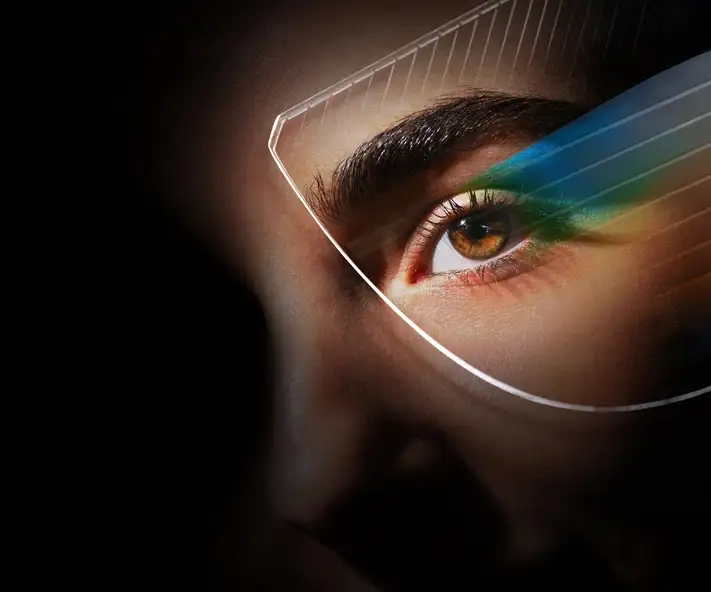
Geometric reflective waveguides integrate precisely engineered micro-structures that enable bright, clear AR visuals.
Innovation never ends
To be sure, lifting a constraint is not the same as reaching a ceiling.
Optics continue to define what AR smart glasses can ultimately become. Field of view, brightness, transparency, weight, power efficiency – every incremental gain unlocks new use cases. Manufacturing scale was one barrier. Optical performance remains an evolving frontier.
That dual reality shapes the work in Kulim. As Yong explains, the team does not see geometric reflective waveguides as a finished achievement, but as a platform. “Each improvement builds on the last,” he says. What was once considered cutting-edge is now the baseline for the next iteration.
Ultra-thin reflective waveguide prototypes offer high brightness at a 30° field of view. These would enable lighter frames and practical, glanceable applications such as navigation or translation throughout the day. At the other end of the spectrum, prototype geometric reflective waveguides reaching more than 70° field of view expand immersion while preserving clarity and transparency.
Together, this continued innovation gives device makers the flexibility to move from all-day smart glasses to fully immersive systems.
For Stefan, that trajectory is the point.
“This project embodies the pioneering spirit and teamwork that make my job so special,” he says. “Our key to success is innovation. That’s what we do best: turn our partners’ vision into reality through expertise, research, and a shared passion for turning physical boundaries into material solutions.”
AR has the potential to “shape our daily lives as profoundly as the smartphone once did. That means we’re now standing at the precipice of the next big transformation,” Stefan concludes. “And our geometric reflective waveguides are key to making that happen.